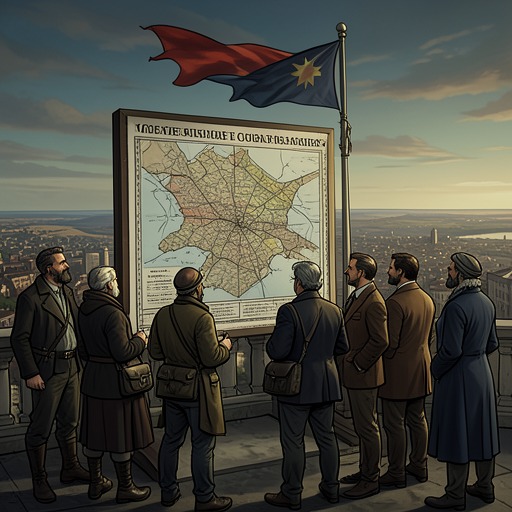
Portuguese colonialism in Angola
Another Day of LifePortuguese colonialism in Angola was a centuries-long system of territorial expansion and extraction, with war and the export of enslaved people at its centre. The book connects that history to Angola’s depopulation and deprivation, and sets the collapse of everyday services during the 1975 war against a much longer record of colonial violence and unequal development.
Expansion and the colonial economy
In 1482, the Portuguese captain Diogo Cão reached the mouth of the Congo River, where the Kingdom of Kongo flourished. The book treats this arrival as the beginning of Portuguese expansion in the region, while distinguishing it from the later conquest of Angolan territory. That process began in earnest in 1573, when Paulo Dias de Novais established a settlement at Luanda and led soldiers down the Cuanza River. The difference between arrival and conquest matters: colonial rule was not established in one moment, but through successive military campaigns and territorial advances.
The account identifies the capture and export of enslaved people as the principal reason for Portugal’s presence in Angola. The demand for labour on plantations in the Americas, particularly sugar plantations, connected Angola to a wider Atlantic economy. Historians estimate that three to four million enslaved people were shipped from the territories within Angola’s present borders. For nearly four centuries, the slave trade formed a central part of the country’s history; in the first half of the nineteenth century, slave exports accounted for more than 90 percent of the value of Angola’s exports. The book also traces enduring connections across the Atlantic: significant portions of the populations of Brazil, the Dominican Republic, and Cuba descended from Angolan slaves. It links this history to the later fact that Brazil was the first state to recognize the People’s Republic of Angola, while Cuba provided substantial assistance to Angolan liberation forces.
Conquest, warfare, and colonial status
The slave trade was sustained by repeated warfare. The book cites historians Douglas L. Wheeler and René Pelissier on the persistence of Portuguese military campaigns: between 1579 and 1921, war was the rule rather than the exception, and Portuguese archival documents reportedly record only about five years in a 350-year span in which Portugal conducted no war somewhere in Angola. In this account, military force was not incidental to colonial rule; it helped secure the territories and people on which the colonial economy depended.
Portugal’s administration also made Angola a destination for deportees and people cast out of Portuguese society. The book describes the colony as a penal colony and notes that Lisbon referred to it as the country of deported, expelled, and socially discarded people. It argues that the low status of many settlers contributed to Angola’s backwardness, placing the character of the colonial population alongside the extractive purpose of the system. These details show a colonial order that treated Angola both as a source of wealth and as a place to which Portugal could send people it did not wish to retain at home.
Demographic and social consequences
The book presents Angola’s low population as the cumulative result of several forces. Over three centuries, large numbers of inhabitants were enslaved and transported across the Atlantic. Forms of slavery persisted within Angola as forced labour until as late as 1962. The account also estimates that around 700,000 Africans emigrated, mainly to Congo (Zaïre), Namibia, and the Republic of South Africa. Malnutrition and the absence of even basic health care further contributed to low population levels.
Colonial neglect extended beyond population loss. The book describes a society in which more than 90 percent of the population was illiterate, only 10 percent of black Angolans lived in cities, and many people remained in subsistence conditions or near-destitution. It says colonial powers maintained the African population at a very low nutritional and cultural level. These claims connect material deprivation to a system of rule, rather than presenting poverty and illiteracy as isolated national characteristics. The account also describes Angola as multiracial, with white and mixed-race communities as well as African communities; the society left by colonialism therefore cannot be reduced to a simple division between colonizers and colonized.
From colonial rule to liberation and war
The book dates the large-scale liberation struggle to the middle of the twentieth century. In 1948, young Angolan intellectuals created the cultural movement Vamos descobrir Angola. Its members published two issues of the literary periodical Mensagem before the police shut it down. The movement’s editor and leader was the poet Viriato da Cruz; his close associates included Agostinho Neto and Mário de Andrade. By placing this cultural initiative in its account of liberation, the book presents the struggle as having an intellectual and literary dimension as well as a later military one.
More than 95 percent of Angola’s European inhabitants left in 1975, travelling to Portugal and other countries, especially Brazil, although some later returned. The exodus accompanied the end of Portuguese rule and the onset of a war in which the country’s already fragile systems came under renewed pressure. The book does not reduce those wartime failures to colonialism alone, but its scenes of the early-October city make the inherited vulnerability concrete: the water-pumping stations stood near the front and were repeatedly destroyed after repairs, leaving residents short of water. Firefighters had abandoned their posts, and soldiers later attempted to use a fire engine to carry water to the front; the conspicuous vehicle was hit and left in a ditch. Garbagemen had also departed, and rubbish accumulated in the streets as the remaining population struggled to maintain ordinary life.
Colonial afterlives in the wartime city
The scarcity of water reveals how civilian survival and military geography had become inseparable. In a later account, a hotel tap produces no water, and the receptionist says the city has gone without it for three days as the last wells run dry. A cook gives the narrator water from a tin barrel. The episode is immediate and specific, but it also echoes the earlier account of the pumping stations: a city’s ability to continue depended on vulnerable infrastructure and the labour of those able to keep it functioning.
The same dependence appears on the military side. The MPLA’s only aircraft in Luanda was an ageing DC-3 flown by Ruiz, who carried ammunition and flour from Brazzaville, delivered supplies to besieged towns, and brought seriously wounded people back to Luanda. The city’s water supply, meanwhile, depended on Alberto Ribeiro, the only person described as able to repair the pumps on the Bengo River. These wartime details do not establish that colonialism alone caused each breakdown. They show instead the conditions in which the independent country’s survival was being contested: long histories of extraction and deprivation formed the background to a present where a single pilot, engineer, or damaged pump could have consequences for an entire city.